Mitch Galloway, Farm News Media; Video by Ian Kast, Farm News Media
EAST LANSING — Expect American footballer and midfielder — you might know him as “Captain America” — Christian Pulisic to play on it.
Yep, that’s right. A year from now, the world’s best soccer players will compete in the FIFA World Cup, hosted in North America, with matches played on a turfgrass system developed by Michigan State University (MSU) and the University of Tennessee, thanks to FIFA-sponsored research.
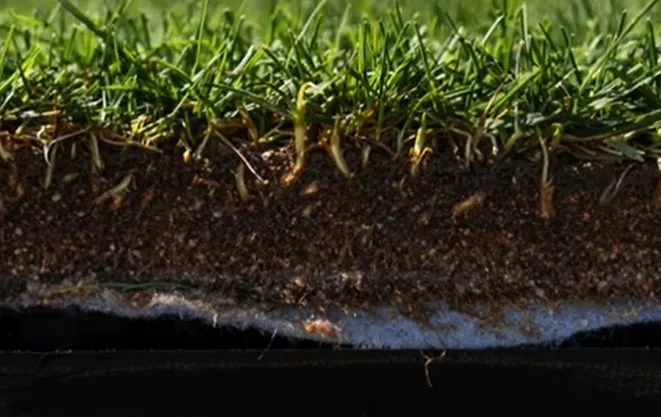
First things first, John “Trey” Rogers III of MSU must prepare for the 2025 FIFA Club World Cup challenge, held June 14 to July 13 at various U.S. venues. It’s a test trial in several venues for the shallow turf profile (STP) system, which consists of sod on plastic over the permavoid drainage system, to see the results of the work Rogers and MSU’s Turf Management Program students have put into it.
“It’ll be a very proud moment when we watch these games,” Rogers, professor of turfgrass management at the Department of Plant, Soil, and Microbial Sciences at Michigan State University, told Michigan Farm News.
At MSU’s Hancock Turfgrass Research Center in late May, Rogers discussed how the STP will be installed in the stadiums that have chosen to use the system. The advantage is that the playing surface allows for match play as soon as it is installed, lasts an indefinite period, and “mimics … what an athlete feels when they’re playing on a regular soccer field with six to eight inches of root zone,” Rogers said.
Since the 1960s, MSU has been a leader in turfgrass development, having created the indoor grass for Detroit’s Pontiac Silverdome during the 1994 World Cup soccer tournament.
According to FIFA, the governing body of the competition, World Cup games must be played on natural grass, which for MSU and the University of Tennessee is produced at sod farms in Washington, California, Colorado, North Carolina, Florida, New Jersey, Vancouver, Canada, and Monterey, Mexico.
“I mean, you’re still a little bit nervous, right?” Rogers said. “I can remember ’94. Even though we were very confident that our grass was where we wanted it to be — as good as we could make it — we were still a little bit nervous. I’m positive that we’ll have that effect again, and I’m also positive that we have better systems this time around than we did in ’94, and we were successful in ’94.”
The 2026 FIFA World Cup features 48 countries, with competition running from June 11 to July 19. Stadium sites are in three different host countries — Canada, Mexico and the U.S.
Among the 16 fields in the tournament, eight need temporary sod or grass.
According to MSU Junior goalkeeper Zac Kelly, who’s also a student in MSU’s Turf Management Program, it’s important to capitalize on his turfgrass education.
“You never know when you might get another opportunity or when you might get to experience something that might never come back again,” he told MSU last November.
Rogers said the project couldn’t be completed without students like Kelly. Currently, 90 students are enrolled in MSU’s Turf Management Program.
“They’re the lifeblood,” Rogers added. “They’re very dedicated, they’re very thorough, they’re so enthusiastic, and they’re so very bright. I feel sometimes like we’re cheating. They’re so good that it makes things very, very, easy.
“And I’m one of the luckiest guys in the world for the staff we have.”




Comments